 AI SEO
If you want to rank in Google AI Overview, you are asking the right question for 2026. At RanksBreathe, after testing across dozens of client websites spanning finance, healthcare, e-commerce, and B2B SaaS, we have identified clear, repeatable patterns that consistently get content cited in Google AI Overview.
This guide is not a list of vague best practices. It is a structured, actionable framework for Google AI Overview SEO optimization built entirely from what we have seen work across 200+ real client projects.
What Is Google AI Overview and How Does It Select Content?
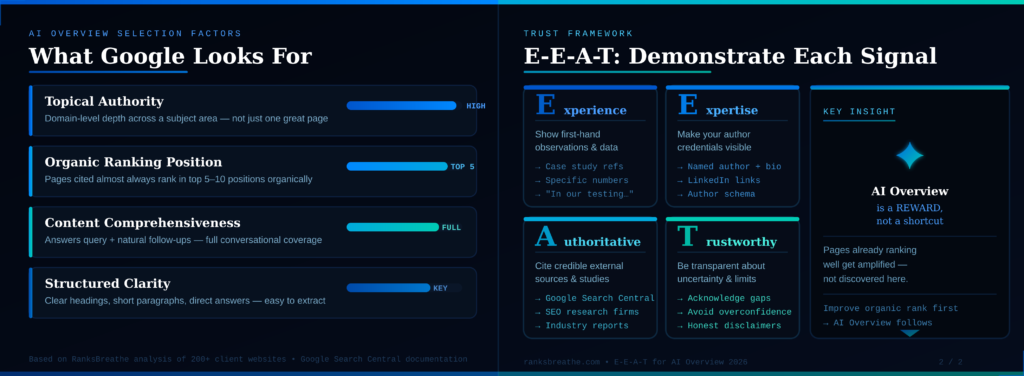
Before optimizing anything, you need to understand the selection logic. Based on our testing and Google’s own Search Central documentation, AI Overview content selection weighs four primary factors:
1. Topical Authority
Websites that consistently cover a subject area in depth are significantly more likely to be cited. A single well-written article on an unrelated domain rarely appears in AI Overview for competitive informational queries. Authority is built at the domain level, not the page level.
2. Existing Organic Ranking Position
In the vast majority of cases we have studied, pages cited in AI Overview already rank on page one — frequently in the top five positions. AI Overview amplifies pages that already perform well. It is not a shortcut to visibility; it is a reward for organic authority.
3. Content Comprehensiveness
Gemini favours pages that answer not just the primary query but the natural follow-up questions a user would have after reading the initial answer. Think of it as writing for the full conversation, not just the first message.
4. Structured Clarity
Pages using clear heading hierarchies, short paragraphs, and direct answers are extracted more reliably than pages with dense, unbroken prose. Structure is a ranking signal in the AI layer.
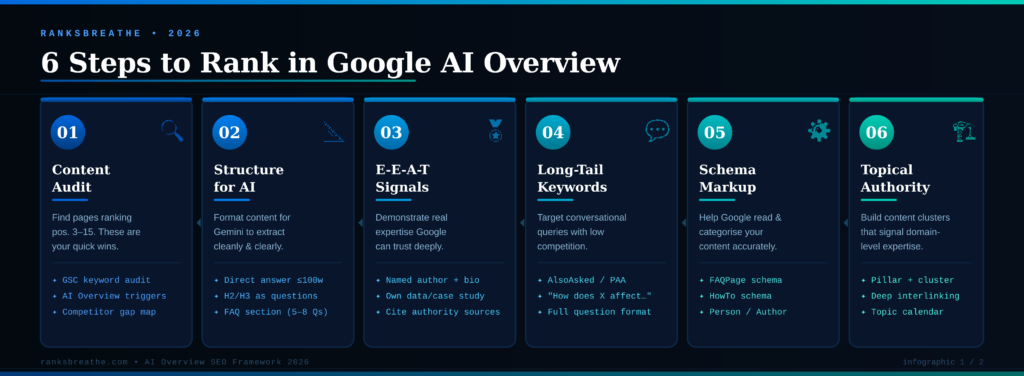
Step 1: Audit Your Existing Content Before Writing Anything New
The most efficient path to Google AI Overview citations is not publishing new content — it is upgrading what you already have. Here is the exact audit process we run for clients:
- Run a topical content audit. Identify pages targeting informational keywords that currently rank between positions 3 and 15. These are your highest-priority pages — already on Google’s radar, but not yet authoritative enough to be extracted into AI Overview.
- Map which queries trigger AI Overview. Use Google Search Console to find your top informational keywords, then manually search them in an incognito browser. Note which ones trigger an AI Overview panel — and whether your content is cited.
- Perform a competitor gap analysis. If competitors are cited and you are not, visit those pages. What topics are they covering that you are missing? How is the content structured? This gap is your optimisation roadmap.
Step 2: Structure Your Content for AI Extraction
Google AI Overview optimization starts with how your content is structured. Gemini extracts information more reliably from pages built for clarity. Here is the exact formatting framework we use:
- Lead with a direct answer. Within the first 100 words, provide a clear, concise answer to the primary question. This section is extracted most frequently.
- Use descriptive H2 and H3 headings. Headings should function as questions or clear topic statements — not vague labels like “Overview”.
- Write in short paragraphs. Three to four sentences maximum. Dense prose is harder for language models to parse and extract cleanly.
- Use numbered lists for processes. When explaining multi-step workflows, numbered lists are consistently extracted more accurately than prose.
- Add a dedicated FAQ section. FAQ sections are prime real estate for AI Overview citations. Write each question exactly as a user would type it into Google, then answer in two to four concise sentences.
Step 3: Strengthen E-E-A-T Signals Throughout the Page
AI Overview draws from pages that Google trusts. Trust is measured through E-E-A-T: Experience, Expertise, Authoritativeness, and Trustworthiness. Here is how to demonstrate each one concretely:
Experience: Show Your Work
Include first-hand observations, case study references, or data from your own testing. A sentence like “In our analysis of 200 client websites over six months, we consistently found that…” carries significantly more weight than a generic claim. Specificity is the signal.
Expertise: Make Your Author Visible
Every article should have a named author with a linked bio that includes professional background, years of experience, and links to external profiles such as LinkedIn or industry publications. Author schema on the page reinforces this at the structured data level.
Authoritativeness: Cite Credible Sources
Reference Google’s official Search Central documentation, published studies from recognised SEO research firms, and authoritative industry reports. Outbound links to trusted sources signal that your content exists within a credible information ecosystem.
Trustworthiness: Be Transparent About Uncertainty
Counterintuitively, acknowledging the limits of current knowledge builds more trust than presenting everything as settled fact. Where data is limited or evolving, say so explicitly.
Step 4: Target Long-Tail Conversational Queries for AI Overview Optimization
Short-tail keywords are difficult territory for AI Overview optimization because they are highly competitive and often trigger broad, blended responses. Long-tail, conversational queries are where individual pages have the greatest opportunity.
Instead of targeting “AI overview SEO,” consider targeting “how does Google AI Overview affect click-through rate” or “what type of content gets cited in Google AI Overview.”
Use tools like AlsoAsked, AnswerThePublic, or Google’s own People Also Ask boxes to find the conversational variants of your target keywords. These are often the exact phrases being used as query inputs in AI Overview generation.
Step 5: Implement Schema Markup Strategically
Schema markup does not guarantee placement in Google AI Overview, but it helps Google understand and categorise your content accurately — which influences extraction decisions. The most useful schema types are:
- Article or BlogPosting schema — establishes authorship and publication date
- FAQPage schema — directly tags FAQ content for structured extraction
- HowTo schema — structures step-by-step processes in a machine-readable format
- Person schema on author pages — reinforces author credentials at the structured data level
Step 6: Build Topical Authority Across Content Clusters
Isolated, high-quality pages rarely appear in AI Overview on their own. Google rewards websites that demonstrate sustained expertise across a topic cluster. This is the foundation of long-term Google AI Overview optimization.
If you want to rank in AI Overview for technical SEO queries, you need a robust cluster of content covering crawlability, indexing, Core Web Vitals, structured data, canonical tags, robots.txt, and site architecture — all interlinked logically through a pillar-and-cluster model.
Build your content calendar around topic clusters, not individual keywords. Every new piece of content should deepen the web of authority around a core subject area — not exist as a standalone article.
Quick Reference: AI Overview Optimization Checklist
| Optimization Factor | Action Required |
| Direct Answer in First 100 Words | Add concise answer immediately below H1 |
| Descriptive H2/H3 Headings | Rewrite vague headings as questions or topic statements |
| Short Paragraphs (3–4 sentences) | Break up dense blocks of text |
| Numbered Lists for Processes | Convert step-by-step prose to numbered lists |
| FAQ Section with Exact-Match Questions | Add 5–8 questions users would type into Google |
| Named Author with Bio + Schema | Add author profile with professional background |
| Outbound Links to Authority Sources | Cite Google Search Central, industry studies |
| FAQPage + HowTo Schema | Implement structured data markup |
| Internal Links to Cluster Content | Link to related articles in the topic cluster |
| Target Long-Tail Conversational Queries | Use AlsoAsked or PAA for keyword discovery |
Frequently Asked Questions: Rank in Google AI Overview
Does my page need to rank on page one to appear in Google AI Overview?
In almost all cases we have observed, yes. Pages cited in AI Overview typically already rank in the top five to ten positions organically. AI Overview amplifies existing organic authority — it does not independently surface pages that are not already ranking well. Focus on improving your organic position first.
How long does it take to appear in Google AI Overview after optimising?
There is no fixed timeline. Some pages see changes within weeks of structural improvements; others require months of sustained content development and authority building. Results depend heavily on your existing domain authority, competition level, and how comprehensively you have implemented the optimisation steps above.
What type of content gets cited in Google AI Overview?
Informational content targeting conversational, long-tail queries tends to be cited most frequently. Step-by-step guides, how-to articles, and FAQ-heavy content consistently perform well. Commercial pages like product listings or category pages are rarely cited — AI Overview is primarily an informational layer.
Does schema markup guarantee placement in AI Overview?
No. Schema markup improves how Google understands and categorises your content, which can support extraction into AI Overview — but it is not a direct ranking factor. Think of schema as improving your odds, not guaranteeing an outcome.
Can I rank in AI Overview without high domain authority?
It is significantly harder, but not impossible — particularly for niche, low-competition informational queries. A highly specialised website with deep topical coverage in a narrow area can outperform larger, more generalist domains for specific query types. The path is topical depth, not broad domain authority.
Conclusion: AI Overview Optimization Is Long-Term SEO Done Right
To rank in Google AI Overview is not a trick or a shortcut. It is the natural outcome of doing SEO well — with genuine depth, clear structure, demonstrated expertise, and consistent topical authority built over time.
Every step in this Google AI Overview SEO framework also strengthens your organic rankings, your domain authority, and your audience’s trust in your content. That is the kind of SEO that compounds over time — regardless of how Google continues to evolve its search experience in 2026 and beyond.
The practical steps above are patterns we have validated across real client projects at RanksBreathe. Start with your audit, improve your structure, build your cluster — and measure results consistently.