 AI SEO
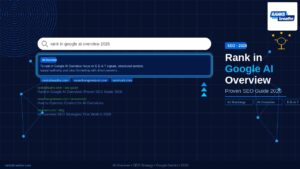
If you have searched anything on Google recently, you have likely noticed something different sitting right at the top of the results page – before any blue links, before any ads, before anything else.
A clean, AI-generated box summarises the answer to your query. It pulls from multiple websites, presents a cohesive response, and sends most users on their way without a single click.
That is Google AI Overview – and if you manage a website, a blog, or any kind of online business, understanding it is no longer optional.
AI Overview SEO is now one of the most discussed and debated topics among digital marketers worldwide – and for good reason. The way Google surfaces content has fundamentally shifted, and websites that fail to adapt are already losing ground.
At RanksBreathe, we have been monitoring Google AI Overview 2026 trends since the feature’s initial rollout and testing how different types of content respond to it across client websites. This article brings together everything we have learned – what Google AI Overview actually is, how it works, and what it genuinely means for your SEO in 2026.
What Is Google AI Overview?
Google AI Overview is an AI-powered summary that appears at the top of Google Search results for certain queries. Rather than immediately displaying ten organic links, Google generates a direct answer – compiled from multiple web sources – and displays it in a highlighted box above everything else.
Previously known as Search Generative Experience (SGE), Google officially launched AI Overview in May 2024 across the United States and has since expanded it to over 100 countries including India, the UK, and Australia. By late 2024, Google confirmed AI Overviews were appearing for billions of searches every month.
The technology powering it is Google Gemini – Google’s large language model. Gemini reads, interprets, and synthesises content from multiple web pages and produces a single, readable answer with source citation cards displayed alongside or below the summary.
One important clarification: Google AI Overview is not replacing Google Search. It is changing how search results are presented – particularly for informational and research-driven queries.
How Does Google AI Overview Work?
Understanding how AI Overview generates its summaries is critical if you want your content to appear in it.
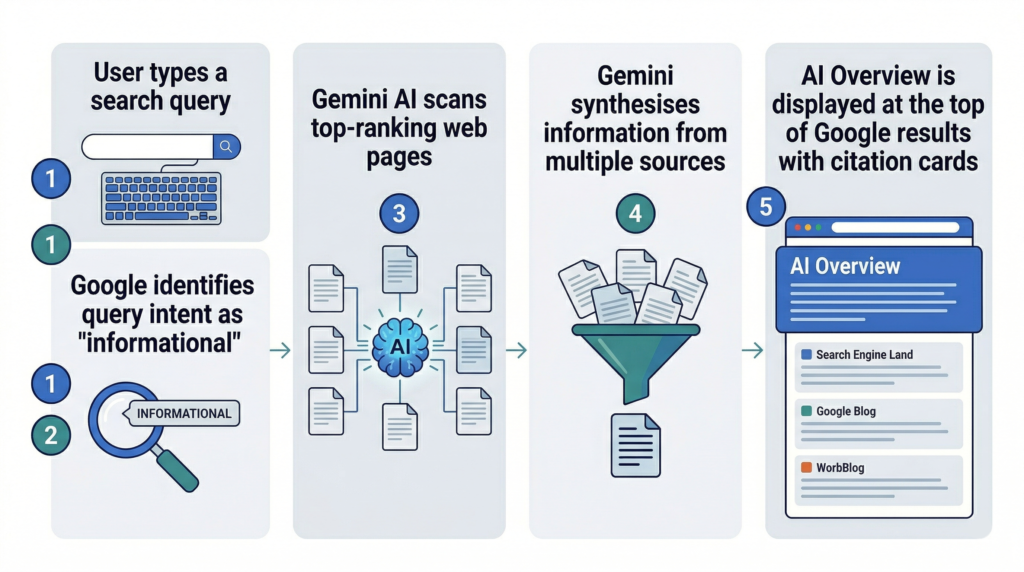
Based on Google’s official documentation and our own testing at RanksBreathe, here is how the process works:
1. Google identifies query intent If a search is informational — the user wants to learn something rather than buy something – AI Overview is far more likely to trigger. Transactional and navigational queries rarely produce an AI Overview.
2. Gemini scans high-authority pages Google’s Gemini model does not pull from random websites. It draws primarily from pages that already have strong topical authority, clear E-E-A-T signals, and well-structured content. If your page ranks on page one, it stands a real chance of being scanned.
3. Information is synthesised across multiple sources Unlike a Featured Snippet – which extracts content from a single page – AI Overview blends insights from several pages into one cohesive response. This is why no single website dominates every AI Overview response.
4. Source attribution is included Websites cited in AI Overview appear as small link cards. These are not traditional blue links, but they do generate traffic – typically from users who want to read further or verify the information.
One observation from our team: AI Overview responses are not static. Google refreshes them based on content freshness and changing search behaviour. A page cited today may be replaced tomorrow if newer, more authoritative content is published.
What Types of Searches Trigger Google AI Overview?
Not every query triggers an AI Overview. Based on our analysis of thousands of queries across client projects, here is what consistently appears:
Queries that commonly trigger AI Overview:
- “How to” questions – How to improve domain authority
- “What is” questions – What is schema markup
- Comparison queries – WordPress vs Webflow for SEO
- Multi-step process questions – How to do a technical SEO audit
- Definition and explainer queries
Queries that rarely trigger AI Overview:
- Navigational queries – Gmail login
- Brand-specific queries – Nike shoes price
- Local intent queries – plumber near me
- Breaking news searches
This distinction matters enormously for content strategy. If your website targets informational keywords – and most content-driven sites do – AI Overview is directly shaping how your pages are discovered and consumed.
How Google AI Overview Is Affecting SEO in 2026
Let us be direct: Google AI Overview has made SEO more nuanced. Here is how the landscape has shifted.
Click-Through Rates Have Changed – But Not Uniformly
Early data from BrightEdge and Semrush indicated that organic CTR dropped for queries where AI Overview appeared. More recent analysis shows the impact varies significantly by query type.
Branded and transactional queries are largely unaffected. Informational queries – especially those AI Overview answers comprehensively – do see lower CTR for top-ranked pages. However, websites cited as sources within AI Overview often see an improvement in traffic quality. Visitors who click through from citation cards tend to have higher engagement, lower bounce rates, and stronger conversion intent.
Zero-Click Searches Are a Real and Growing Trend
For simple factual queries, millions of users now get their answer from AI Overview without clicking any link. If your content strategy relies heavily on short, surface-level answers, this is a threat worth taking seriously.
Content Depth Has Become a Genuine Competitive Advantage
Pages cited in AI Overview share one consistent trait: they go beyond the primary question. Rather than just answering “What is a canonical tag,” the strongest pages explain when to use it, when not to use it, common implementation mistakes, and how to audit for issues. That depth signals expertise to both Google’s ranking algorithm and Gemini’s summarisation model.
What This Means for Your Website Right Now
If you are not actively thinking about Google AI Overview as part of your SEO strategy in 2026, here is where to begin:
Audit your informational content. Identify pages targeting question-based or educational keywords. These are the pages most exposed to AI Overview – and the pages with the highest potential to be cited within it.
Strengthen your E-E-A-T signals. Google explicitly draws AI Overview content from pages demonstrating Experience, Expertise, Authoritativeness, and Trustworthiness. Author bios with real credentials, first-hand insights, cited data, and a consistent publishing track record all matter more than they ever have.
Write for depth, not just keyword density. The era of 500-word blog posts ranking for informational queries is over. AI Overview rewards comprehensive, well-structured content that genuinely serves the reader.
Format your content for extraction. Clear H2 and H3 headings, short paragraphs, direct answers early in the article, and FAQ sections at the end all make it significantly easier for Gemini to identify and cite your content accurately.
Frequently Asked Questions About Google AI Overview
What is Google AI Overview in simple terms?
Is Google AI Overview available in India?
Does Google AI Overview affect website traffic?
How is Google AI Overview different from a Featured Snippet?
Can my website appear in Google AI Overview?
Final Thoughts
Google AI Overview is not a temporary experiment. With billions of queries served through it monthly and Google’s continued investment in Gemini, this is the new baseline for how search works.
The good news is that the foundations of strong SEO – genuine expertise, comprehensive content, clear structure, and trustworthy authorship – are precisely what AI Overview rewards. If you have been doing SEO properly, you are already better positioned than most.
At RanksBreathe, we help websites adapt their content strategies to perform in this new search environment. The next step is understanding how to optimise your content specifically to appear in AI Overview – which we cover in full detail in our next article.